
Lead-Acid Battery Complete Production Line Sourcing Guide: Six Key Criteria from Product Definition to TCO Evaluation
Setting up a new lead-acid battery manufacturing plant requires huge capital investment. The production line equipment you select directly determines the quality of plates, battery assembly & sealing, unit production cost, and ultimately your market competitiveness. Lead-acid manufacturing covers smelting, mechanical processing, formation charging & discharging, heat sealing and other strict processes. Minor process fluctuations in any section will trigger mass quality issues including insufficient capacity, excessive self-discharge, electrolyte leakage and shortened service life. This guide sorts out practical selection standards, providing actionable references for new lead-acid factories sourcing complete production equipment.
1. Clarify Your Lead-Acid Battery Specifications & Plate Process First
Before communicating with equipment suppliers, you must fully define your product portfolio. Lead-acid manufacturing equipment is highly customized. Machinery designed for one battery type often delivers low efficiency or cannot run other products at all.
Will you produce automotive starter batteries, motorcycle batteries, electric vehicle batteries, stationary energy storage lead-acid batteries or industrial tubular batteries? Each category requires distinct casting, pasting, assembly, heat sealing and formation lines.
Besides, your plate process route dictates equipment selection: conventional lead alloy plates, calcium alloy maintenance-free plates, tubular plates or gel battery plates? Equipment tailored for one formula may not match the material properties of others — paste coating thickness, curing & drying parameters, acid filling volume, heat sealing standards and formation charging curves vary greatly between different processes.
Misjudging your product positioning at the early stage will force costly line modification or full equipment replacement later. Before contacting suppliers, confirm your target Ah capacity range, plate technology, cycle life requirements and designed line speed.
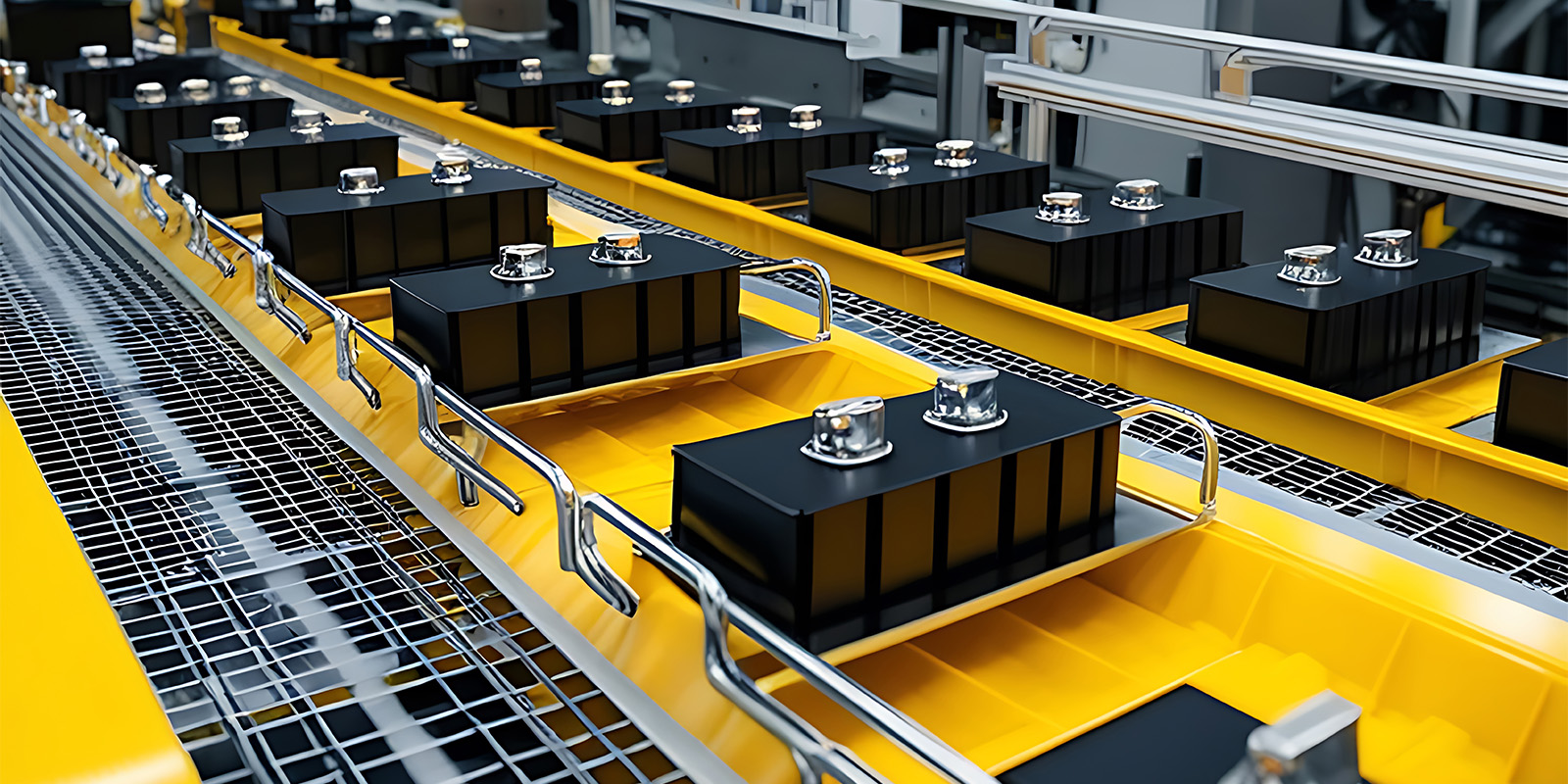
2. Take Precision, Line Speed & Yield as Core Evaluation Metrics
In lead-acid production, product quality and operational efficiency are inseparable. Equipment must maintain stable machining precision under continuous high-speed operation to control overall manufacturing costs.
First, focus on plate processing accuracy: consistency of grid thickness and paste coating directly affects battery capacity, self-discharge and cycle life. Request clear specs on coating thickness tolerance and continuous running speed.
For complete processes including grid casting, pasting, slitting, assembly and heat sealing, well-matched integrated lines should achieve a comprehensive yield rate ≥ 99.5%. Precision in plate slitting, lug welding and case-cover alignment is critical. Dimension deviation, cold solder joints or incomplete heat fusion will lead to mass defects such as short circuits and electrolyte leakage.
Do not only refer to equipment peak empty-run speed. Verify stable long-term throughput, format changeover time and precision retention during multi-day continuous production. A machine with fast nominal speed but drifting precision after several hours performs far worse than a slower unit with stable consistent parameters.
3. Inspect Automation Level & Full Production Line Integration Capacity
Automation not only cuts labor expenses, but also stabilizes processes and enables full production traceability. Manual operation introduces human errors that raise reject rates of plates and finished batteries.
Highly automated integrated lines support seamless data communication between all stations, with all production data centralized to the Manufacturing Execution System (MES). However, standalone premium machines without synchronized coordination will create process bottlenecks and reduce overall line output.
The core value of equipment lies in full-line coordination rather than individual single-unit parameters. Ask suppliers the following key questions:
- Can their equipment connect to your existing or planned MES system?
- Are casting, pasting, assembly, heat sealing and formation stations centrally linked, or do they operate as isolated data silos?
Fully integrated lead-acid complete lines shall reach an overall equipment effectiveness (OEE) ≥ 95%, representing stable continuous operation with minimal unplanned downtime.
4. Reserve Capacity Expansion Space & Ensure Long-Term Equipment Versatility
Lead-acid production equipment amortizes over many years. The machinery you purchase today needs to adapt to future battery format upgrades and capacity expansion demands.
- Can the line be upgraded by adding parallel stations to boost output?
- Does the manufacturer adopt modular designs for phased capacity expansion?
Prioritize compact, cost-effective modular equipment compatible with a wide range of lead-acid battery models. This point is especially vital for enterprises starting with small pilot lines and planning large-scale factory expansion later. Modular design also simplifies maintenance: if one station breaks down, can the rest of the line operate independently? Premium integrated lines support dual operation modes: full-line linkage or standalone single-unit control, with independent control systems for each station, drastically cutting full-line downtime throughout the equipment service life.
5. Evaluate Supplier’s Practical Lead-Acid Industry Experience & After-Sales Support
Sourcing complete lead-acid battery production equipment is not a one-time transaction, but a long-term strategic partnership.
The supplier’s track record in core procedures including grid casting, pasting, slitting, group welding, heat sealing, acid filling and formation cycling is decisive. Verify whether they have delivered mass-production lines matching your target battery specifications and plate technology. Years of specialization in lead-acid equipment manufacturing acts as a core screening criterion.
Beyond equipment hardware, assess the full after-sales system: technical support response speed, on-site operator training, and matching plate formula & process technical guidance. Well-maintained integrated lines achieve single-unit failure rate ≤ 1%. In case of breakdowns, responsive after-sales service minimizes production loss. Suppliers with local service outlets and mature remote diagnostic systems are worth slight premium costs.
6. Calculate Total Cost of Ownership Instead of Only Comparing Equipment Purchase Prices
The upfront quotation only covers initial investment. You must evaluate the full Total Cost of Ownership (TCO) across the equipment lifecycle, including overall power consumption (a full lead-acid line usually exceeds 150kW total power), annual maintenance fees, consumable replacement costs such as molds & cutting tools, and production losses caused by equipment downtime.
Low-cost entry-level equipment often consumes more energy, suffers frequent breakdowns and carries expensive spare part costs, leading to higher long-term comprehensive expenses. Quality loss costs shall also be considered: high-precision, high-yield integrated lines reduce scrap rates of plates and finished batteries, cutting waste of lead, sulfuric acid and plastic housing materials.
Request full data disclosure from suppliers: power consumption per finished battery, standard maintenance intervals and Mean Time Between Failures (MTBF). Request factory visits to operating lines of the same model — real mass-production performance data outweighs marketing descriptions.
Selecting suitable complete lead-acid battery production equipment relies on matching your battery specifications and plate process route, while balancing machining precision, operational stability and expandability, with full control over the total lifecycle cost.
For manufacturers of all types of lead-acid batteries, SANBEN’s complete lead-acid battery production line solution delivers full automatic processing from grid casting, pasting, group assembly, heat sealing, acid filling to formation testing. The line’s cycle speed fits all automotive and energy storage lead-acid batteries, with overall equipment effectiveness over 95% for stable mass production of full-range lead-acid models. The integrated line supports dual operation modes: full-line linkage and independent single-unit running, paired with user-friendly HMI and separate control systems for each station, lowering operation and daily maintenance thresholds. If you plan to build or renovate a complete lead-acid battery manufacturing plant, this all-in-one SANBEN solution deserves in-depth consideration.